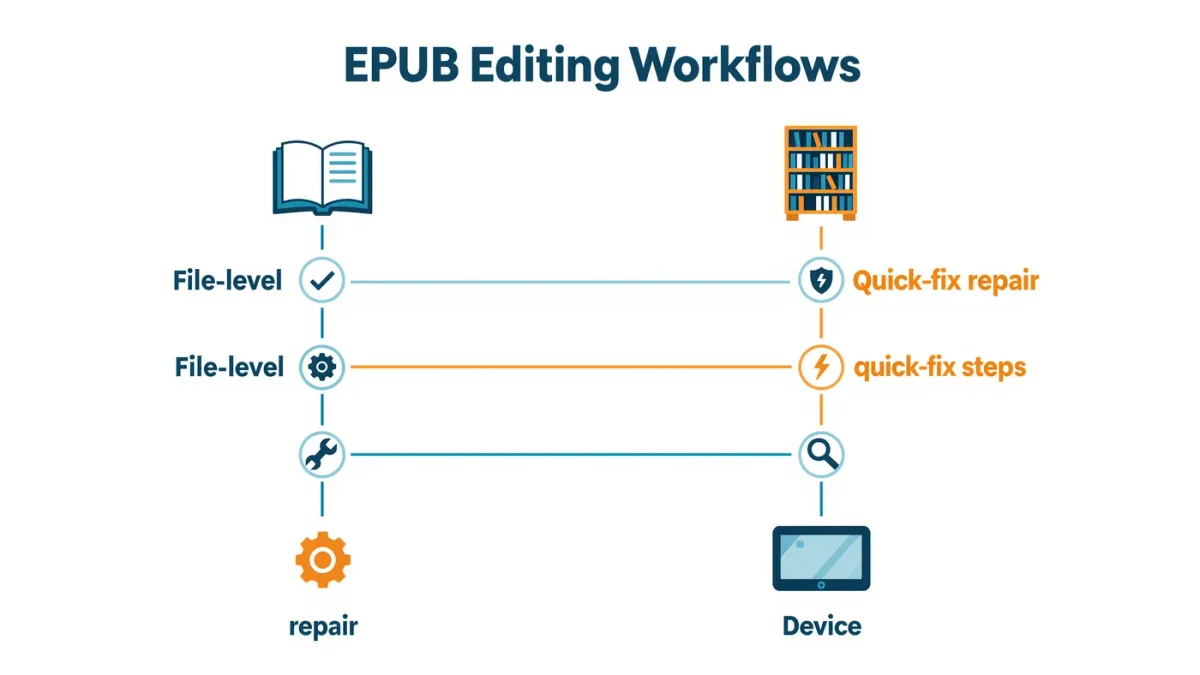
Use Sigil when the job is a deep, file-by-file repair of a single EPUB, and use Calibre's Edit Book when the fix should ride along with the rest of your library workflow. That's the compressed verdict, and it holds because the two tools overlap less than their feature lists suggest. Both are free and open source; both edit the XHTML, CSS, and package files inside an EPUB; per each project's documentation, both include validation and both run on Windows, macOS, and Linux. The difference is posture: Sigil is a dedicated EPUB editor that opens one book and goes deep, while Edit Book is a panel inside a library manager, one right-click away from conversion and device transfer.
What does each tool actually give you?
| Capability | Sigil | Calibre Edit Book |
|---|---|---|
| Opens EPUB 2 / EPUB 3 | Yes, per documentation | Yes, per documentation |
| Bundled validation | Yes, integrated validator | Yes, checks against the spec |
| Live preview pane | Yes, approximate rendering | Yes, with split view |
| Regex across all files | Yes, multi-file Find & Replace | Yes, including saved searches, per documentation |
| Context | One book at a time | Inside your whole library |
| Extras | Plugin ecosystem of its own | Snippets, saved searches tied to library workflow |
When is Sigil clearly the right tool?
Reach for Sigil when the EPUB is the project. Structural surgery — rebuilding a broken table of contents by editing the NCX or NAV directly, renaming and re-linking files safely inside the package, fixing a malformed OPF, or doing a chapter-by-chapter pass on a converted manuscript — sits squarely in Sigil's home territory. Its single-book focus is a feature during long editing sessions: fewer panels, fewer distractions, a Book Browser that always shows the whole file tree of the one book you're repairing. If you proof EPUBs for other people — a regular production job, not an occasional fix — the dedicated editor earns its slot in your dock for that reason alone.
When does the Calibre editor win?
Win when the edit is one step in a pipeline. The classic loop: convert a DOCX to EPUB in Calibre, notice a styling problem, hit Edit Book, fix the CSS once, save, convert again or send straight to the device — all without leaving the library manager. Per Calibre's documentation, Edit Book ties into the conversion pipeline, so a fix applied to the book's files persists through later operations, and its saved searches let you re-run the same cleanup regex across many books over time. If your books live in Calibre anyway — and for most of this audience they do — the friction of opening a second tool rarely pays off for small jobs.
Can you just use both?
You should, honestly, and there's no penalty: both tools are free, both respect the EPUB structure, and edited files pass between them without conversion. A common division of labor among indie authors: Edit Book for quick fixes inside the library workflow, Sigil for the final structural pass before publishing, where its focused interface and validator make a last audit easier. The one rule that matters with either tool: validate after every change, and render on a real device or reading app before you call the book finished — both editors' previews are approximations, per their documentation, not proof of how every renderer behaves.
How do the two tools differ on validation and previews?
Both ship validation, but the philosophy differs. Sigil integrates a validator as a first-class part of the editing loop — you're working on one book, and the tool wants that book to pass before anything else happens. Calibre's Edit Book checks your work against the EPUB specification too, per its documentation, but sits inside a workflow where conversion and device transfer are the neighbors; it's easier to save and move on without checking, so the discipline is on you. On previews, both offer rendered views of the current file, and both are approximations of real devices, per their documentation. The practical rule either way: validate after every session, and proof once on actual hardware before publishing. The editor you used stops mattering the moment the file leaves your machine — only its correctness travels.
What about cost, updates, and longevity?
Both projects are free and open source, so cost is identical and licensing imposes no practical limits. The interesting difference is update cadence and community. Sigil is maintained as an independent open-source project with releases published on GitHub, and its version history shows steady maintenance of the editor itself. Calibre is one of the longest-maintained projects in the e-book world, with frequent releases that touch the editor, conversion engine, and device drivers together. For a user, that means Calibre's editor improves in step with the library around it, while Sigil's releases are free to focus purely on EPUB editing. There is no wrong choice here, and no lock-in — your files are standard EPUB either way, which is the whole point of the format. Install both, keep both updated, and let the size of the job in front of you pick the tool.
Which should a beginner install first?
If you already run Calibre, learn Edit Book first — it's already installed, and the fixes you need at the start (a broken TOC, a bad cover, one CSS rule) are all within it. Add Sigil when you find yourself doing production work on EPUBs as objects, or when a repair needs the dedicated editor's focus. The tools aren't rivals; they're the same competence at two scales, and knowing which scale your problem is turns a two-hour evening into a ten-minute one.