Price your ebook between $2.99 and $9.99 on Amazon, because per Amazon KDP's royalty page you earn 70 percent inside that band and only 35 percent outside it — meaning a $2.99 title nets about $2.05 while a $1.99 title nets under $0.70. Then move the price deliberately: launch low, hold mid-list, discount on schedule.
MonBook Pro publishes information, not financial advice — treat these as documented platform terms, not a prescription for your catalog.
Why Is $2.99 the Floor That Matters?
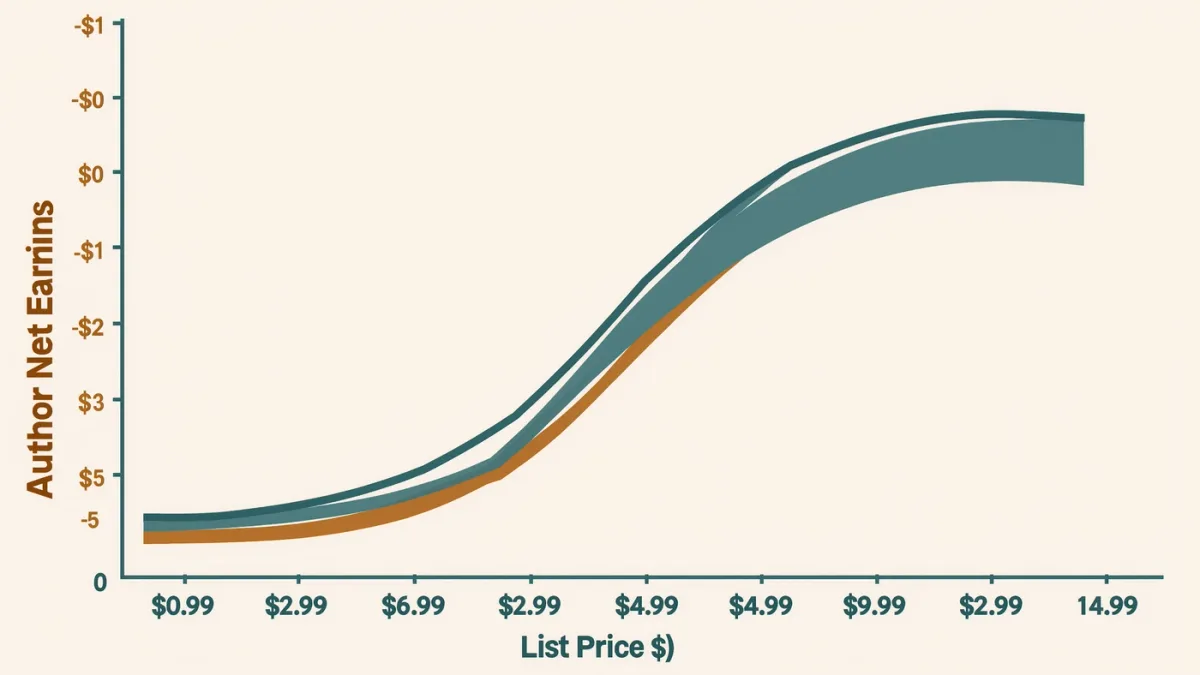
Because the royalty cliff at $2.98 is brutal and it is the single most expensive pricing mistake new authors make. Per Amazon KDP's terms (2025), the 35 percent tier applies below $2.99 and above $9.99. Pricing at $0.99 feels friendly but pays roughly $0.35 per sale; pricing at $2.99 pays roughly $2.05. The wide stores do not all share this cliff — Apple Books pays a flat 70 percent at any price, per Apple's terms for authors — but Amazon still moves most indie volume, so its band anchors the market.
What Price Should a First Book in a Series Carry?
Discounted or free. The economics of series publishing make the first book a customer-acquisition tool: if books two through five sell at $4.99 each with 70 percent royalties, the roughly $2 you sacrifice on book one buys a reader worth up to $14 in royalties across the series. Many indie authors hold book one at $0.99 permanently, or run it free if wide — Amazon's own matching usually follows other stores, since per its pricing terms Amazon matches free prices detected elsewhere.
How Does the 70 Percent Tier Actually Pay Out?
Two details shrink the headline rate. First, at the 70 percent tier Amazon deducts a delivery fee based on file size, per its terms page — negligible for prose, meaningful for image-heavy titles. Second, royalty is calculated on the sale price in each marketplace, and VAT or sales tax handling varies by country, so your per-unit net differs across stores even at one list price. Kobo and Apple treat taxes differently in their reporting; check each platform's statements rather than assuming a single net number.
| List price | Amazon tier | Approx. net (US, prose) |
|---|---|---|
| $0.99 | 35% | ~$0.35 |
| $2.99 | 70% | ~$2.05 |
| $4.99 | 70% | ~$3.47 |
| $9.99 | 70% | ~$6.94 |
| $12.99 | 35% | ~$4.55 |
Note the trap in the last row: at $12.99 you earn less per sale than at $9.99. Nonfiction authors who need a higher price point often publish through channels that pay flat 70 percent, or accept the 35 percent tier knowingly.
What Is Price Pulsing and Does It Still Work?
Price pulsing is cycling a title between full price and a discount every few weeks, so the price change itself triggers storefront placement in deal newsletters and recommendation slots. Sites that list bargain ebooks generally require a price drop to $2.99 or below for feature consideration. The mechanics are documented: change the list price in your KDP or Kobo dashboard and the storefronts update within hours to a couple of days. What no source can guarantee is the sales lift — genre, cover, and number of reviews dominate outcomes, and pulsing a book with weak positioning just marks it down.
How Should Promotions Be Sequenced?
- Pick a date two to four weeks out and book newsletter placements that match your genre.
- Drop the price one to two days before the promo runs so storefronts reflect the deal everywhere.
- Run the discount for five to seven days — long enough for algorithmic placement to compound.
- Return to full price on a set day; leaving a book discounted trains readers to wait.
In KDP Select you can instead use a Kindle Countdown Deal, per Amazon's terms, which keeps your royalty at the promotional price tier and shows the regular price struck through — a visibility perk free price changes lack.
What About Free as a Price?
Permanently free — permafree — remains a working discovery tool for wide authors with series, even though it sacrifices all revenue on that title. On Amazon you cannot set $0.00 directly; per KDP's pricing terms, Amazon matches free prices found at other retailers, so authors publish free on Kobo or Apple and wait for the match. The economics only make sense as book one of a series with proven read-through: free downloads convert to paid sequels at modest rates, and a title that gives away ten thousand copies while selling two hundred sequels has spent a lot of goodwill for little return. Track the read-through rate weekly, not monthly, and be willing to return the title to $0.99 if free stops feeding the series.
How Do You Read Your Pricing Data Once the Book Is Live?
Every portal reports units and royalties, but the pricing signal lives in the relationship between rank and daily sales. When a price cut lifts rank sharply but total revenue falls — more units, less money per unit — you have learned your book is price-elastic in the wrong direction. When a price rise barely dents units, you were underpriced. Give each experiment a clean window of at least two weeks with no overlapping promotions, and change one variable at a time; authors who change price, cover, and categories simultaneously learn nothing from the result. Keep a simple spreadsheet of date, price, units, and revenue — after a year you will have better pricing intuition than any advice article can give you.
Should You Price Differently per Store?
You can, and at scale it pays. Because Apple's flat 70 percent has no $9.99 ceiling, a $14.99 nonfiction title earns more there than on Amazon's 35 percent tier. Aggregators and direct portals all support per-store pricing. The overhead is real, though: every promotion must be mirrored across stores or you risk Amazon price-matching a stray discount you did not intend. Most authors simplify to one global price and revisit only for nonfiction or boxed sets.