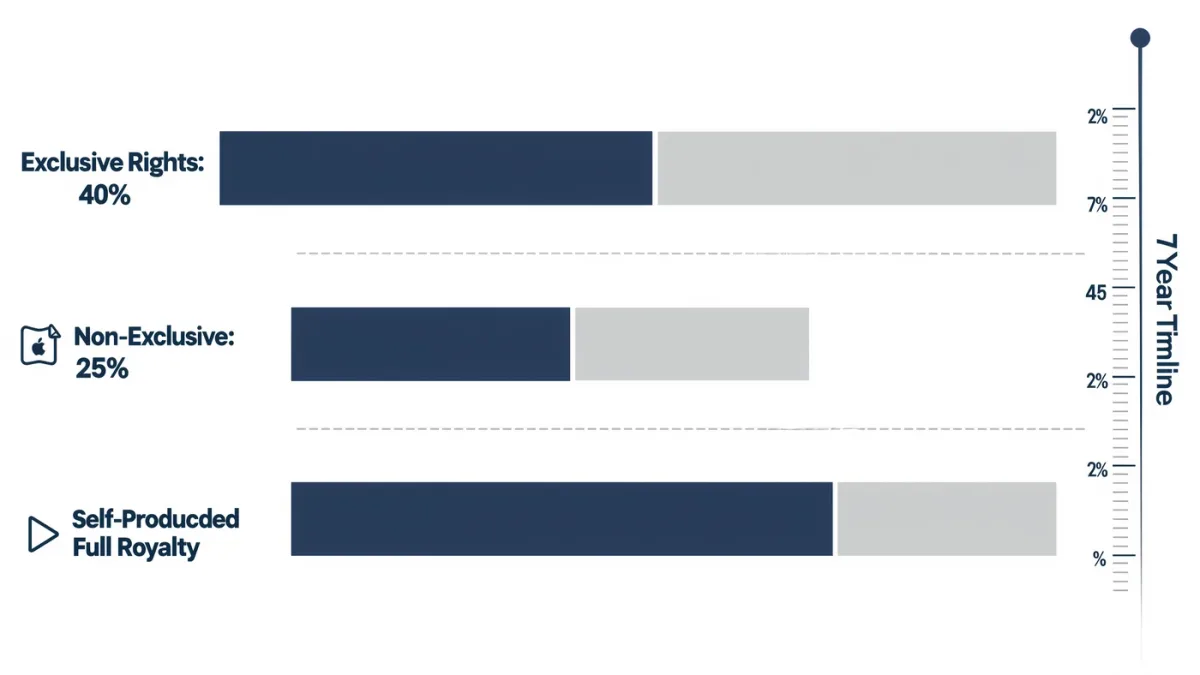
If you self-published your book, you hold the audio rights until you sign them away — and per ACX's published terms (Amazon's audiobook marketplace), exclusive distribution through ACX pays narrators and rights holders a combined rate tied to 40 percent of the audiobook's price at the 70 percent royalty option, while non-exclusive distribution drops to 25 percent. The choice between narrating yourself, paying up front, or splitting royalties is the biggest financial fork in indie audio.
What Exactly Are Audio Rights?
Audiobook rights are a distinct bundle from print and ebook rights: they cover the recording, production, and distribution of a spoken version of your work. When you publish an ebook through KDP or any retailer, you license only that edition — audio remains yours. This is why traditional publishing contracts negotiate audio separately, and why indie authors suddenly find themselves holding a sellable asset the moment a book performs. The US Copyright Office treats the audio recording as its own copyrighted work, which is why every audio contract should specify who owns the resulting master files.
How Does ACX Structure Its Deals?
Per ACX's terms as of 2025: rights holders can produce an audiobook by paying a narrator a flat fee (typical per-finished-hour market rates quoted through 2025 run roughly $100 to $400 plus), or by offering a royalty share where the narrator receives half of the rights holder's royalties in exchange for no up-front fee. Distribution choices carry the exclusivity trade-off:
| ACX arrangement | Royalty | Where it sells |
|---|---|---|
| Exclusive, 70% option | 40% of price | Audible, Amazon, iTunes only |
| Non-exclusive | 25% of price | Same three, you keep no other options there |
The exclusive term runs seven years — a long commitment that authors frequently underestimate.
What Are the Alternatives to ACX?
Wide audio distribution has matured. Aggregators and platforms like Findaway Voices (now part of Spotify's audiobook operation following its 2022 acquisition) distribute to many retailers and library services, letting you price and sell outside the Audible ecosystem; Spotify's own audiobook program has expanded indie access through the mid-2020s. Other services route audiobooks to library platforms, where licensing often pays per checkout or per copy sold at retail-plus terms. The trade-off is simple: less Audible dominance, more administration, and no seven-year lock.
Is Royalty Share a Fair Deal?
It depends on the book's existing sales. A royalty-share narrator invests tens of hours on spec; per ACX's structure they receive half your royalty stream for the contract's life. For a book with weak current sales, few professional narrators will accept a share, and the ones who will may not lift production quality. For a series backlist with proven sales, share deals are reasonable for both sides. The alternative — paying per finished hour up front — means you keep the full royalty and all rights, at the documented market range of roughly $100 to $400+ per finished hour, so a 10-hour audiobook is a four-figure investment before marketing.
What Should You Check Before Signing Any Audio Contract?
- Term length: seven years of exclusivity is a long time; shorter or non-exclusive terms preserve future options.
- Scope: does the license cover derivative formats, translations of the recording, or AI narration rights? AI voice clauses began appearing explicitly in audio contracts in the mid-2020s as synthetic narration spread.
- Ownership of masters: who holds the recordings when the term ends.
- Payment basis: royalty on retail price versus net receipts — the same percentage means very different money.
- Reversion: conditions under which rights return to you if sales stall.
Authors' advocacy organizations, including the Authors Guild, have published guidance on audiobook contract terms through the mid-2020s; treat their checklists as a baseline before signing anything.
How Long Does Production Take and What Does the Process Involve?
Audiobooks are slower than every other format. A finished-hour of audio represents roughly two to three hours of studio work plus proofing, and a typical novel runs eight to twelve finished hours. ACX production timelines published on its help pages tell authors to expect the finished audiobook roughly a month or more after a narrator accepts, depending on schedule; wider distribution through other platforms runs similar calendars. After delivery comes quality control — a listening pass against the manuscript, corrections, then retail processing, which on Audible has historically taken up to a few weeks before the listing appears. Plan marketing around the confirmed retail date, not the delivery date; the gap between the two is where launch plans quietly die.
What Is Whispersync and Why Does It Affect Pricing?
Audible and Kindle editions can link through Whispersync, letting readers switch between reading and listening while keeping their place. Per Amazon's published explanation, the ebook and audiobook sync when sold as a pair — and when an audiobook is Whispersync-enabled, Audible members can sometimes add the audio companion at a steep discount after buying the ebook. For authors this is a real trade: the discounted add-on sales pay royalty at the discounted price, but the pairing measurably helps sell ebooks to readers who like both formats. ACX-distributed titles get the feature automatically; decide with eyes open, because it is one more reason the exclusive path pays differently from the wide one.
Should You Sell Audio Rights to a Publisher Instead?
Sometimes, yes. If a specialist audio publisher offers an advance, professional production, and broad distribution, that is a legitimate route — the advance is real money and their marketing reach can exceed a solo effort. Weigh it against the royalty math of self-production: an advance of a few thousand dollars versus a lifetime of 40 percent royalties on a book that keeps selling. Books with proven ebook sales generally earn more self-produced; untested books are better bets for licensing out.