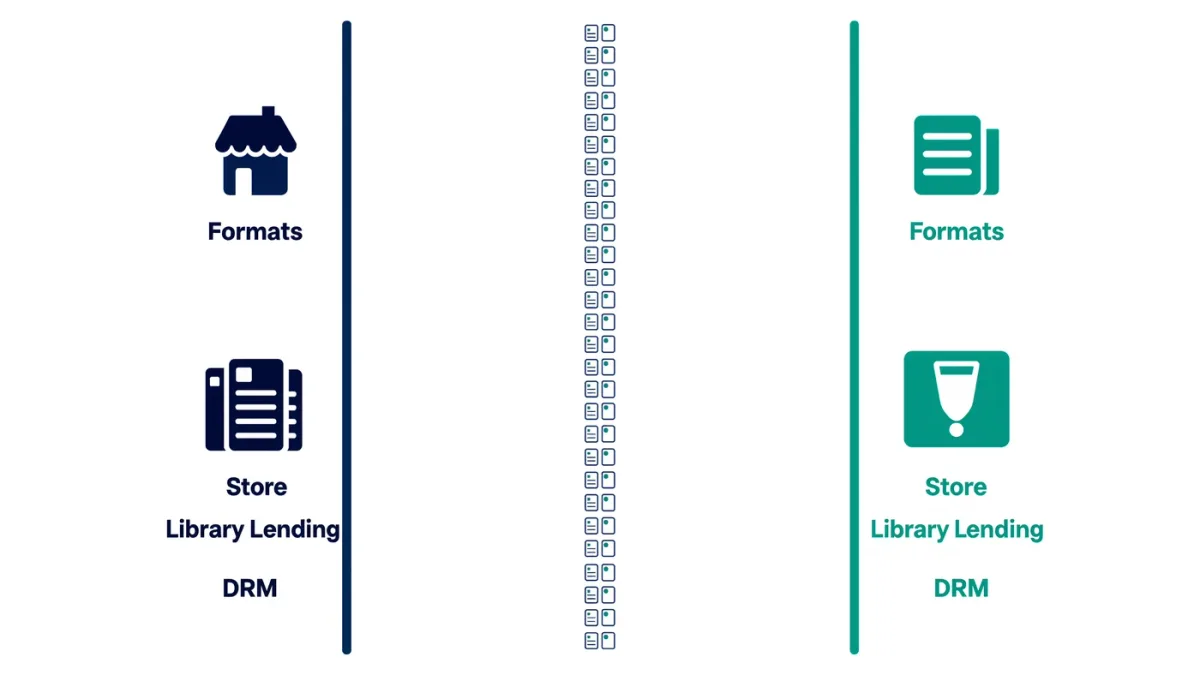
If you buy books from a store and borrow from the library, Kobo is the more polished ecosystem as of April 2026 — its store, OverDrive library integration, and Reading Life features are all first-party. If your library is a folder of DRM-free files in odd formats, PocketBook is the freer machine: its spec sheets list support for far more formats, a music player, even text-to-speech, and it never tries to move your books into a walled garden. Both makers' documentation supports these characters, and the honest comparison is about ecosystems, not raw hardware.
MonBook Pro publishes information, not purchasing advice — every format and store claim below traces to the makers' own pages.
What formats does each brand actually support?
This is PocketBook's home turf. Its spec pages list roughly twenty supported formats across current models — EPUB, PDF, MOBI, DJVU, CBZ/CBR for comics, plus audio formats for its speaker-equipped models. Kobo's documentation centers on EPUB and EPUB3, PDF, and its own kepub format, with CBZ/CBR support on many models; the practical gap shows up with niche files like DJVU scans or older MOBI files, where a PocketBook simply opens them and a Kobo may not. Amazon-purchased books belong on Kindles by license — neither brand opens DRMed purchases from another store, which is the quiet constant behind every format discussion.
| Capability | Kobo (per maker) | PocketBook (per maker) |
|---|---|---|
| Core formats | EPUB, EPUB3, PDF, kepub, CBZ/CBR | EPUB, PDF, MOBI, DJVU, CBZ/CBR and more |
| Bookstore | First-party Kobo Store, strong regional reach | First-party store, smaller catalog emphasis |
| Library borrowing | OverDrive integration built in | Varies; sideloading and partner services |
| DRM handling | Adobe DRM for EPUB purchases | Adobe DRM plus wider file tolerance |
| Extras | Reading stats, Pocket integration history | Audio playback, text-to-speech on some models |
How do the stores and DRM differ in practice?
Kobo's store is the deeper retail experience: promotions, a subscription reading service in supported regions, and purchases that flow straight onto the device. Its EPUB purchases carry Adobe DRM, and Kobo's own terms describe how your licenses work — broadly standard for the industry, which is to say the book lives with the store. PocketBook also runs a store, but the brand's identity is format tolerance: books you own as files, sideloaded over USB or its send services, with Adobe DRM support for borrowed and purchased EPUBs where required. The walled-garden framing that fits Kindle does not fit either brand cleanly — but Kobo nudges you toward its ecosystem's conveniences, and PocketBook nudges you toward being your own librarian.
What about library borrowing?
Kobo's built-in OverDrive integration is the standout: in supported countries you borrow library books directly on the device with your library card, per Kobo's documentation. PocketBook users generally borrow through a computer and Adobe Digital Editions, or through library apps where available, then sideload — the same destination by a longer road. If library books are half your reading and OverDrive serves your region, that single feature weighs more than any format count. Check your library's digital service before deciding; availability is regional and changes.
How do the hardware lineups compare?
Both brands cover the mainstream sizes with 300 ppi panels where premium and Kaleido 3 color where colorful. Kobo's lineup as of spring 2026 includes compact Clara models, the Libra family with page-turn buttons, the larger Sage, and color Libra models — each documented on Kobo's site. PocketBook's range runs wider in shape: the Era series with its 7-inch screen, color Era models, inkPad large-format readers, and budget Verse line, per its product pages. Physical page-turn buttons appear on Kobo Libra and on PocketBook Era; waterproofing appears on both brands' spec sheets for specific models. Panel quality is comparable on paper; firmware character is where Kobo's polish shows and PocketBook's spartan-but-tolerant interface does its work.
Which should you choose by reader type?
Store loyalist and library borrower: Kobo, for the integrated store and OverDrive path. Sideloaders with big mixed-format libraries: PocketBook, for format breadth and its file-friendly attitude. Travel readers who want audiobooks from files: PocketBook models with audio output. Readers who value polish, stats, and a coherent ecosystem above all: Kobo. And if you live where Kobo's store or OverDrive is weak, PocketBook's regional flexibility — multiple interface languages, broad file support — is a real advantage the spec sheets undersell.
How do firmware and sync behave over the years?
Differently, in ways that matter to long-term owners. Kobo ships regular firmware updates with reading statistics, interface refinements, and new store features, and its Rakuten-synced bookmarks and highlights carry across Kobo devices and its smartphone apps. PocketBook also issues firmware updates, and its cloud service keeps libraries and reading positions in step, but the update cadence and polish sit a notch below Kobo's — the classic trade of character for freedom showing up a second time. Both brands let you install updates over Wi-Fi, per their support documentation. If you are the kind of reader who resents an interface changing under you, PocketBook's quieter cycle is a small mercy; if you want the ecosystem to keep improving itself, Kobo's record is the stronger one on the makers' own release notes.
What did the sources not establish?
Prices, which move constantly and vary by region — check both makers' pages on purchase day. Comparable battery-life measurements: each maker quotes weeks under its own conditions, and no named independent cross-test was verifiable as of April 2026. Long-term durability is likewise undocumented in any form we could source; the used market's opinion of each brand is anecdote, not data.