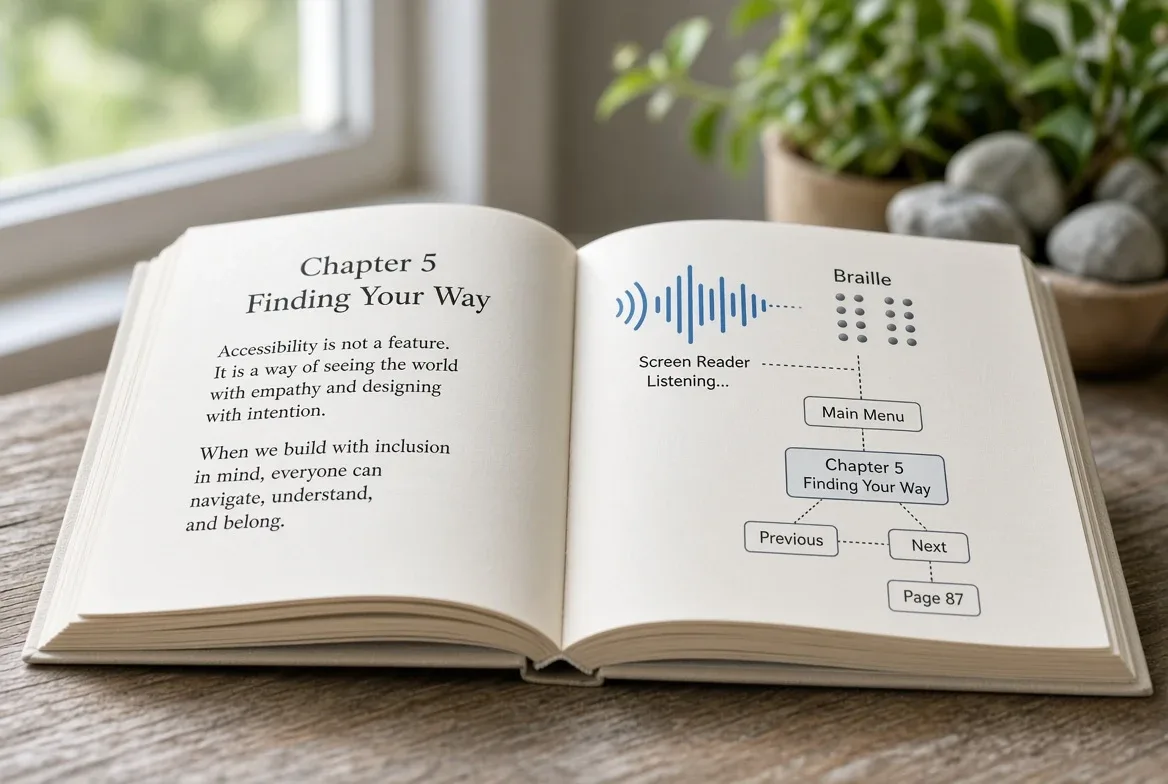
The European Accessibility Act is an EU directive that requires digital products and services sold to European consumers, including ebooks, e-readers, and ebook retail platforms, to meet defined accessibility standards, and it has been enforceable since June 28, 2025. For publishers and self-published authors selling into the EU, that means new titles now need to be "born accessible" rather than retrofitted after complaints arrive.
The law itself, Directive (EU) 2019/882, was adopted back on April 17, 2019, giving the industry six years to prepare before the compliance date arrived. It reaches further than most publishers expect: it covers not just the ebook file itself but the e-reading devices, apps, DRM systems, and e-commerce sites used to sell and read it.
What Does the European Accessibility Act Actually Require?
The EAA requires that digital publications and the platforms distributing them work for readers with disabilities, including blind and low-vision readers who rely on screen readers or refreshable braille displays. The directive sets its requirements in Annex I of the directive, with acceptable technical solutions detailed in Annex II.
For ebooks specifically, a W3C technical note published August 28, 2025 maps those legal requirements onto the existing EPUB Accessibility 1.1 specification, so publishers don't have to interpret the law's general language from scratch. Under that mapping, a compliant ebook needs conformance with WCAG 2 Level AA success criteria, accessibility metadata that lets retailers and library systems surface a book's accessibility features to shoppers, a working table of contents and page-list navigation, and DRM that doesn't block assistive technology from reading the text aloud or reflowing it.
Key takeaway: Compliance isn't about adding a single feature — it's about the file's underlying structure, its metadata, and the retailer or app layer around it all working together.
Which Publishers and Ebooks Are Covered?
The EAA applies to ebooks and the services built around them — e-readers, reading apps, DRM software, and e-commerce sites — sold to consumers in the EU, regardless of where the publisher is based. If you sell into EU storefronts, the law applies to you even if your business has no EU office. Print books are not covered.
The compliance date is tied to when a product or service reaches the market, not when a company was founded. New titles and newly launched services had to meet the requirements starting June 28, 2025.
Which Small Publishers Are Exempt?
The directive carves out a specific exemption for the smallest operators. Under Article 4(5), microenterprises providing services are exempt from the accessibility requirements. Article 3(23) of the directive defines a microenterprise as a business employing fewer than 10 people with annual turnover or an annual balance sheet total not exceeding €2 million.
A separate, narrower exception applies to any business that can demonstrate that compliance would impose a "disproportionate burden" for a specific product or service — a higher bar than simply preferring not to comply, and one a publisher would need to document rather than assume.
What Happens to Older, Already-Published Titles?
This is where the law gets murkier, and where publishers most often get the timeline wrong. The directive includes a transitional provision allowing services already in operation before the application date to continue operating in their existing form for a period after June 28, 2025, rather than requiring instant retrofitting of every backlist title.
But as Publishers Weekly reported, industry experts caution publishers against assuming they have years of breathing room on backlist compliance, since the exact scope of that transition period is still debated and enforcement approaches vary by EU member state. Treating the transition period as a deadline to start work, not a deadline to finish it, is the safer reading.
How Does the EPUB Format Meet These Requirements?
EPUB, the open ebook standard, is built on the same web technologies — HTML, CSS, and related markup — that already carry decades of accessibility tooling and technique. That's the core argument in the W3C's mapping document: EPUB Accessibility 1.1 was designed around WCAG 2 already, so a file built correctly to that specification satisfies most of what the EAA's Annex I asks for, including synchronized audio-text playback (media overlays) for readers who benefit from hearing text read aloud alongside the visual page.
What EPUB conformance can't fix on its own is the retail and reading-app layer. A perfectly accessible EPUB file sold through a storefront that doesn't expose accessibility metadata, or read in an app whose DRM blocks screen-reader access, still leaves a reader locked out. That's why the law addresses the whole chain — file, device, software, and storefront — rather than the file alone.
What Are the Penalties for Getting This Wrong?
The EAA leaves enforcement mechanisms to individual EU member states, and Publishers Weekly's reporting notes that the specific penalty structures remain unclear across the bloc. What is clear is the practical risk: since the requirement runs across the whole publishing value chain, a retailer or distributor that takes accessibility compliance seriously may decline or delist titles that don't meet it, independent of whatever formal fines a given country eventually sets.
Common Mistakes Publishers Make With EAA Compliance
- Treating it as a one-time file conversion. Accessibility metadata, navigation structure, and DRM behavior all need to be right, not just the underlying markup.
- Assuming the microenterprise exemption applies to distributors and retailers too. The size test is about your own business, and larger platforms in your distribution chain still have their own obligations.
- Reading the transition period as a free pass on backlist titles. It buys time to plan, not permission to ignore older titles indefinitely.
- Fixing the file but not the storefront. An accessible EPUB sold through a non-compliant retail listing or app still fails the reader.
Key takeaway: The safest approach for an indie publisher is to build new titles to EPUB Accessibility 1.1 from the start and audit backlist titles on a schedule, rather than waiting for a specific enforcement deadline to force the issue.
For a related reading news perspective, read What the European Accessibility Act Means for Your Ebooks.