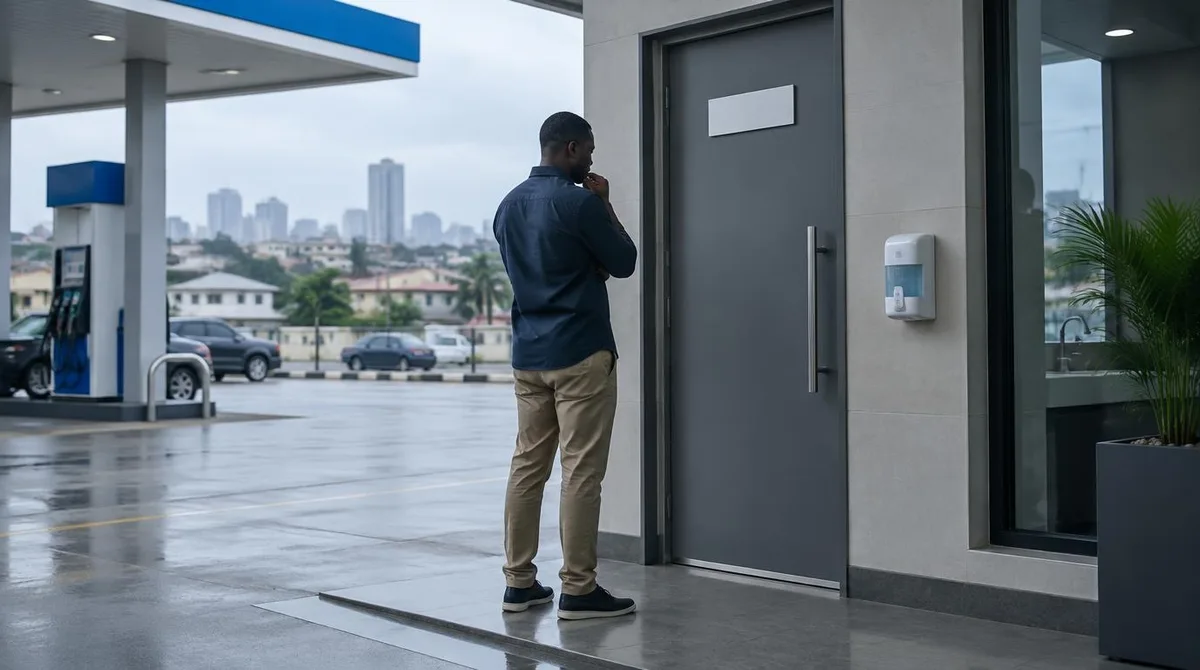
According to Head Topics, the Lagos State Government has called on banks, eateries and filling stations to open their toilet facilities to the public. The appeal came at the 2026 World Toilet Day celebration, and it is framed as a step toward safer sanitation and gender equality. It is a sensible idea on its face. Whether it becomes real access depends on things the announcement does not yet address.
The second opinion worth having here is not about the goal. Few would argue against more safe, private toilets in a busy state. The question is what an appeal can actually achieve, and what the government's own numbers tell us about the gap it is trying to close.
Accessibility, in the end, is about whether a person can actually use a place — a definition we have covered before in plain language on this site, and one that applies to restrooms as much as to e-readers. You can read more about that framing in our explainer on what accessibility actually means, and our broader accessibility coverage follows the same thread: standards matter more than statements. Readers following this should also see Accessibility Definition: What Accessibility Actually Means, in Plain Language.
What the government actually announced
The appeal was made by Olakunle Rotimi-Akodu, the Special Adviser to the Governor on Environment, speaking at the 2026 World Toilet Day celebration held at ASSBIFI House, Alausa. Per the statement from Kunle Adeshina, Director of Public Affairs at the Ministry of the Environment and Water Resources, he encouraged commercial establishments — banks, eateries and filling stations — to make their restroom facilities accessible to members of the public. Such partnerships, the statement said, would complement government efforts and expand access to decent toilet facilities in busy urban communities.
The theme of the event was 'Sanitation and Gender Equality.' Rotimi-Akodu argued that access to safe and hygienic toilets is not merely an infrastructure or environmental issue but a matter of human dignity, personal security and social inclusion. He noted that inadequate sanitation disproportionately affects women and girls, exposing them to insecurity, harassment and difficulties with menstrual hygiene management.
The case behind the appeal
The government's argument rests on consequences, not just comfort. Per the same source, Rotimi-Akodu said the absence of safe, private and hygienic toilets in schools, workplaces, markets, transport terminals and healthcare facilities could undermine women's confidence, school attendance, economic productivity and general well-being. 'Genuine gender equality cannot be achieved without addressing the structural inequalities that limit access to adequate sanitation,' he said.
That is a strong claim, and it is the government's own characterization. It is presented as the special adviser's position rather than an independent finding, and readers should hold it that way. Still, the logic is coherent: if a third of the population cannot reliably find a private, safe restroom in public space, the effects named — attendance, confidence, security — follow plausibly from it. This connects to our earlier piece, How Can Deaf Readers Get The Audio Side Of Books?.
The numbers, and what they leave out
Rotimi-Akodu disclosed that Lagos has more than 1,769 functional public toilet facilities. The state is also constructing 200 public toilets and 80 bathrooms, alongside 100 urinals and 160 handwashing basins across its five divisions. These facilities, he said, form part of the roadmap toward an Open Defecation-Free Lagos.
Here is where a skeptical reading earns its keep. The source does not say how many people those facilities serve, where they are concentrated, or how the new construction is distributed. A figure like 1,769 sounds substantial, but without a denominator it tells us little about whether a market trader or a bus passenger can find a working, clean toilet within a reasonable walk. The announcement gives the total, not the geography.
Standards were named — enforcement was not
To the government's credit, the appeal did not stop at 'open the doors.' Rotimi-Akodu stressed that public toilets must meet standards of safety, accessibility, privacy, cleanliness and gender responsiveness, with special consideration for women, children, older persons and people living with disabilities.
That list is the most interesting part of the announcement, and also the least developed. Naming standards is one thing; saying who checks them, how often, and what happens when a facility fails is another. The source records no enforcement mechanism, no compliance timeline and no answer to the obvious business-side question: who pays for the extra cleaning, maintenance and wear that public use brings? A voluntary appeal that leaves those costs unaddressed tends to produce uneven results — some welcoming storefronts, some locked side doors.
There is also a quiet tension worth naming. The state is asking private businesses to fill a public gap while simultaneously building its own facilities. If the private appeal succeeds, does the public construction program shrink? If it fails, is the build-out enough? The announcement does not say, and honest coverage should not pretend it does.
What to watch next
The useful test of this initiative will be specific and observable: whether any businesses formally sign on, whether the standards named at the event get written into anything enforceable, and whether the 200 toilets, 80 bathrooms, 100 urinals and 160 handwashing basins under construction actually appear, and where. Until then, this is a well-framed appeal with the right priorities — dignity, gender equity, inclusion for people with disabilities — resting on voluntary goodwill and unfinished construction.
On the evidence supplied, the right verdict is measured patience. The framing is better than most sanitation announcements manage, and the disability and gender provisions are explicit rather than bolted on. But an appeal is a beginning, not a result. Lagos has said what good public toilets should be. The next announcement worth reading is the one that says who makes sure they are.